Top Types of Wooden Maze Toys for Buyers
Choosing a wooden maze toy is not just a matter of color or price. Buyers should consider how a child will hold it, guide the pieces, and stay engaged. A tabletop tilt maze asks for steady hands and careful movement. A bead maze invites sliding, looping, and repeated play. A compact travel maze may suit quiet moments, though tiny pieces can be easy to lose.
Maria Montessori, physician and educator, wrote, “The hands are the instruments of man’s intelligence.” Her words offer a useful lens for evaluating hands-on toys. A well-made maze gives children a clear task, visible feedback, and room to try again. Still, no single design suits every child. That is worth remembering.
This guide explores the top types of Maze Wooden toys and the details buyers can compare. Look for smooth, well-finished surfaces, securely attached components, and a level of challenge suited to the intended age range. Check the maker’s age guidance and product specifications; wood alone does not guarantee quality or safety. Consider maze layout, portability, cleaning needs, and whether an adult can inspect the moving parts. A bright finish may catch the eye, but the path should remain easy to follow. Small details matter. The best choice is usually the one that fits a child’s abilities, play setting, and interests—not simply the most elaborate option.
Wooden Maze Toys: Core Design Features and Play Principles
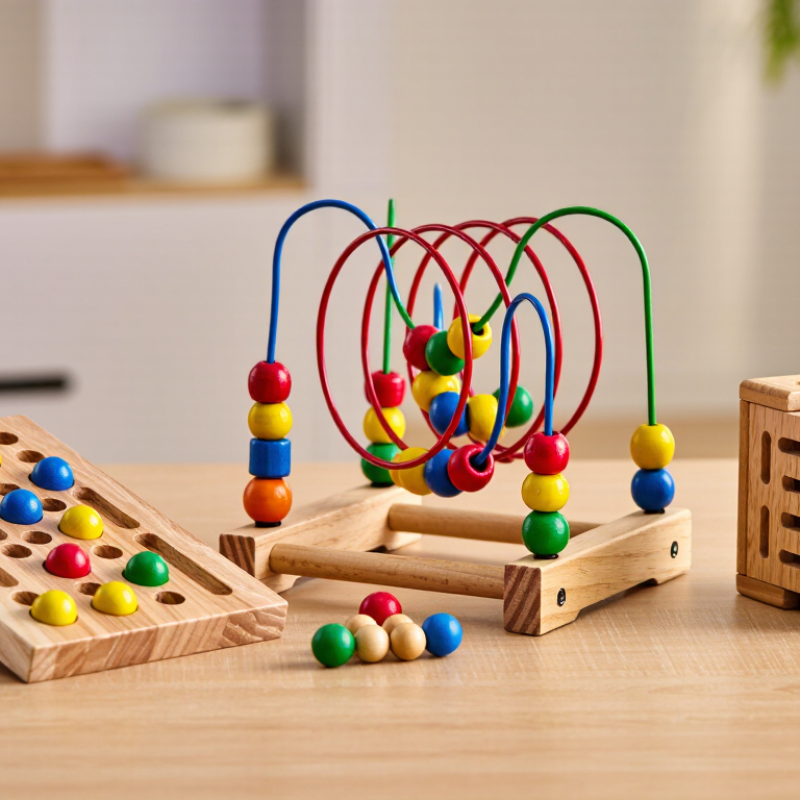
Wooden maze toys turn hand movement into a visible problem-solving task. A child tilts a board, guides a bead through a channel, or slides a piece around a printed path. These movements invite hand-eye coordination and repeated attempts. Common formats include bead-on-wire panels, flat tracing boards, and enclosed-track mazes. Each offers a different feel: wire mazes emphasize steering, while flat boards make routes easier to see. Small details matter.
For buyers, check the path width, finish, stability, and whether any pieces can detach. Smooth edges and securely fixed components matter more than decorative detail. The U.S. Consumer Product Safety Commission’s Toy-Related Deaths and Injuries report estimated 231,700 emergency-department-treated toy injuries among children aged 14 and younger in 2023. That figure covers toys broadly, not maze toys alone, but it makes age grading and construction worth checking. A maze that looks simple in a catalog may frustrate a young child if its turns are tight or its bead sticks. Not every maze fits. Consider the child’s age, grip, and patience, and check the maker’s age guidance before purchase.
Top Types of Wooden Maze Toys for Buyers
Core Design Features and Play Principles
The chart compares common wooden maze toy types across four play and design considerations. Ratings are illustrative qualitative scores on a 1–5 scale, not market research: higher scores indicate a stronger typical fit for that feature. Bead-coaster mazes emphasize hand-eye coordination, while tilt-and-roll designs add more route planning and controlled movement.
Bead-and-Wire Mazes for Early Hand-Eye Coordination
Bead-and-wire mazes give young children a simple way to practise guiding a bead along a fixed path. The child steadies the wooden base with one hand and moves a bead with the other. Curves, loops, and small direction changes invite careful looking and controlled finger movements. These toys can support hand-eye coordination, though play alone does not guarantee a particular developmental result. For buyers, check that the base feels stable and the wire ends are securely enclosed. Smooth, firmly attached beads matter, too.
Tips: Choose a path that suits the child’s age and current skills. Watch for loose parts, rough edges, or a base that tips during play. Stay nearby with toddlers.
A maze with a few broad turns may feel manageable; tighter routes can offer more challenge later. Notice whether beads slide without sticking, but avoid assuming every child prefers the same level of difficulty. Some may enjoy repeating one route, while others move beads quickly and lose interest. That is useful feedback, not necessarily a flaw. Consider the toy’s size, storage needs, and ease of cleaning before buying. Check the maker’s age guidance, and inspect the toy regularly for wear.
Flat-Track Mazes for Guided Pathfinding
Flat-track mazes guide a bead or wooden slider along a shallow, fixed route. The track makes cause and effect easy to see: a child tilts the board, pauses at a bend, then adjusts direction. Buyers should check groove depth, smooth edges, a stable backing, and whether the moving piece can be retrieved easily. A route with two or three junctions offers choices without making every move frustrating. Small details matter. Check the finish, bead clearance, and whether the maze still works when held at a slight angle.
Circana’s 2023 U.S. toy industry review reported $28.3 billion in sales, down 8% from 2022. This broad market figure does not measure maze quality, but it gives buyers reason to weigh play value against construction. Flat-track designs are compact and easy to store, yet fixed routes may lose appeal with repeated use. That trade-off is real. Look for gradual curves, visible endpoints, and enough resistance to slow the piece without jamming it. Observe whether a child can guide the slider independently, and check the maker’s age guidance before choosing. A maze can look simple, but a poorly sized bead or rough groove quickly interrupts play.
Tilt-and-Roll Mazes for Balance and Motor Control
Tilt-and-roll wooden mazes turn small wrist movements into visible progress. A child tilts the board, watches a bead travel, and adjusts before it reaches a corner. This repeated action can support hand-eye coordination and controlled movement. Look for a board that sits steadily on a table, with rounded edges and a smooth, well-finished surface. The path should offer gradual turns as well as tighter challenges. Too much resistance may frustrate beginners; a very loose bead can make the task feel trivial. Test the movement. A gentle tilt should move the bead without a sharp jerk.
For balance practice, notice how the child steadies the board and changes its angle with both hands. The activity mainly exercises fine motor control; it does not replace whole-body balance play. Choose a board that fits comfortably on a lap or tabletop, depending on how it will be used. Check that joints feel secure and that the finish has no rough patches. For younger children, follow the maker’s age guidance and inspect small moving pieces closely. A maze that is slightly difficult can invite another try. Still, the “right” challenge varies, and even a well-made toy may not hold every child’s attention.
Magnetic and Multi-Route Mazes for More Advanced Play
Magnetic wooden mazes add a clear challenge: children steer a steel ball with a wand beneath a transparent cover. Look for a wand that moves smoothly, a ball that stays contained, and a board that sits flat on a table. These details matter during repeated play. A magnet that slips or catches can turn careful steering into frustration. Check whether the track has broad turns and a few narrower passages, rather than one long, difficult bottleneck.
Multi-route mazes offer choices: players can follow alternate paths, backtrack, or aim for different destinations. That makes them useful for experimenting with planning and hand control, though extra routes do not automatically make a toy more engaging. Circana reported that global toy sales fell 7% in 2023 compared with 2022. That market figure does not measure demand for maze toys, but it is a reminder to assess practical value, not just novelty. Inspect the wood finish, covered edges, and route visibility, then consider whether the child can reset the ball without adult help. A little difficulty is productive. Too much can stall play.


Share On: